
Tennis Court vs. Pickleball Court Surfacing: Key Differences
If you're planning a new court installation or considering a conversion project, understanding the differences between tennis court and pickleball court surfacing is essential. The two sports share some visual similarities, but their surface requirements, court dimensions, coatings, and maintenance needs are distinct in ways that significantly affect performance, player safety, and long-term cost.
Whether you're a facility manager, HOA board member, school administrator, or private property owner in Colorado, this guide walks you through everything you need to know before committing to a surface type or a conversion.
Court Dimensions: Size Matters Before the Surface Does
Before diving into surface materials, it helps to understand the footprint differences between the two courts.
A standard tennis court measures 78 feet long by 36 feet wide for doubles play, with a total recommended play area of approximately 120 feet by 60 feet including runoff space. That's a substantial footprint requiring significant surface area and material investment.
A standard pickleball court measures 44 feet long by 20 feet wide, with a recommended total play area of 64 feet by 34 feet. That's roughly one-quarter the size of a tennis court, which has major implications for surfacing costs, drainage planning, and site preparation.
This size differential is also what makes tennis-to-pickleball conversions so attractive: a single tennis court can comfortably accommodate two to four pickleball courts side by side.
Surface Types: What Goes Under Your Feet
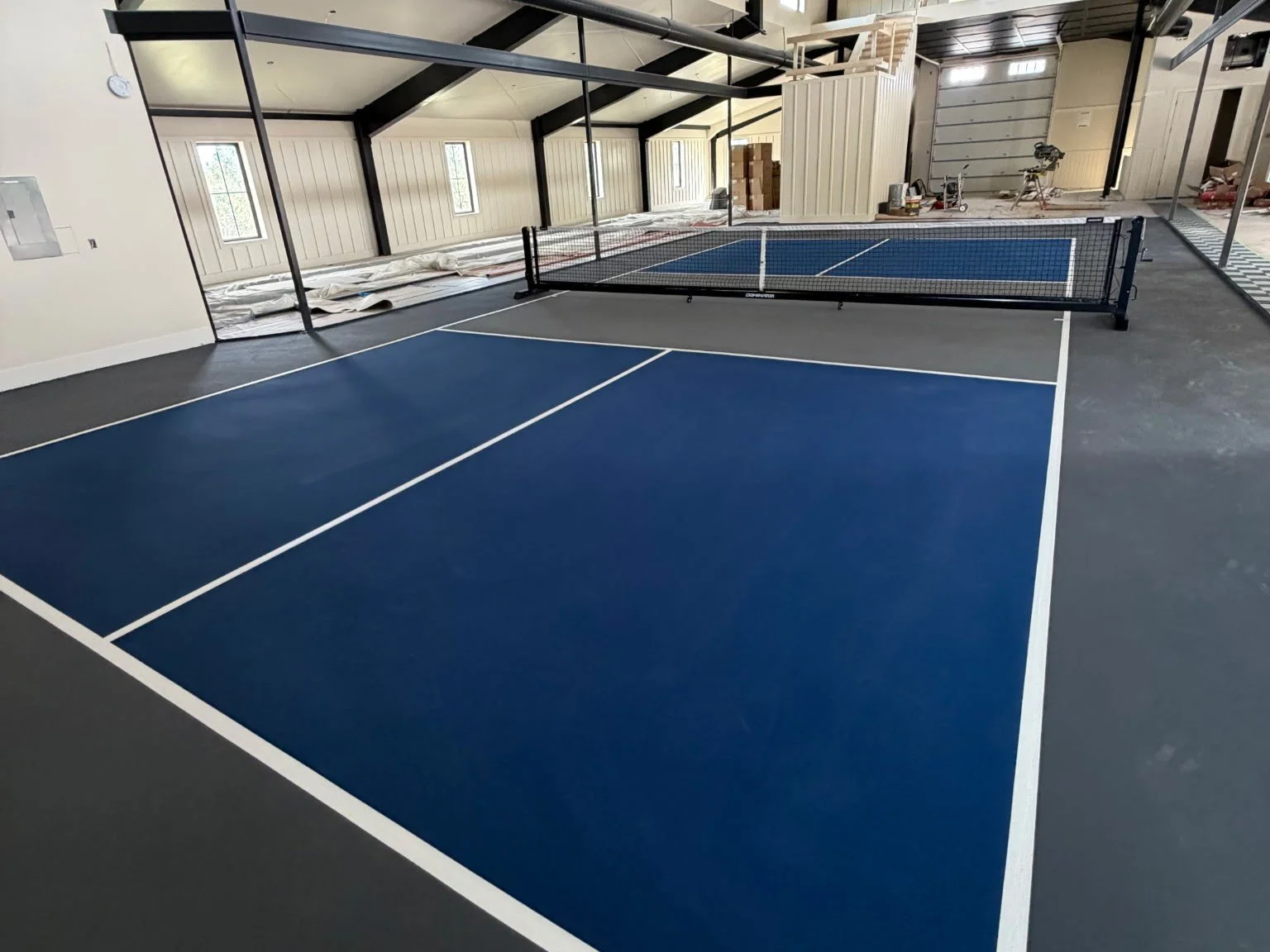
Both tennis and pickleball courts are commonly built on hard court surfaces, though each has specific performance requirements that influence material selection.
1. Hard Court (Asphalt or Concrete Base)
Hard courts are the most common surface type for both sports in North America, and they're the foundation MAC Surfaces uses for most Colorado court projects. Here's how the two compare:
Tennis hard courts typically use an asphalt or concrete base with multiple layers of acrylic resurfacing material applied on top. The texture and cushioning of the final coating are engineered specifically for the pace of play in tennis, where ball bounce height, speed, and consistency across a larger surface area are the primary concerns. MAC Surfaces builds ITF-classified tennis court surfaces designed for consistent ball response, long-term durability, and all-weather performance through Colorado's extreme temperature shifts.
Pickleball hard courts use the same general base construction, but the surface coatings are applied at a smaller scale. Because the court is smaller and the ball (a perforated plastic ball) plays differently than a felt tennis ball, the ideal surface texture for pickleball is slightly different. MAC Surfaces optimizes pickleball court surfacing for player safety with slip-resistant texture, low-maintenance materials that hold up under sun, snow, and heavy play, and customizable color and layout options.
2. Post-Tensioned Concrete: The Gold Standard for Both Sports
One key decision in any court construction project is whether to use asphalt or concrete as the base. Post-tensioned concrete is widely considered the superior choice for serious tennis and pickleball facilities. It prevents surface movement by reducing settling and cracking over time, delivers a longer court life with lower lifetime maintenance costs, and performs consistently without producing uneven bounces or surface warping.
This matters especially in Colorado, where freeze-thaw cycles put significant stress on outdoor surfaces throughout the year. Standard asphalt is more economical upfront but may require more frequent resurfacing and repair. For clients weighing pickleball court vs tennis court surfacing costs in Colorado, the base material choice often has more long-term financial impact than the sport-specific coating applied on top.
3. Clay and Grass Alternatives
Clay and natural grass courts exist predominantly in the world of tennis. Pickleball is almost never played on clay or grass at an organized level, and these surfaces are not typically considered for new pickleball installations. If you currently have a clay court and want to convert it to pickleball, the process involves significant base reconstruction rather than a simple resurfacing.
Tennis surface options go well beyond hard courts, clay, and grass. For a deeper look at the full range of surface types, including carpet, modular tile, and artificial grass, how each affects play style, and how Colorado's climate factors into the decision, see ourcomplete guide to the different types of tennis court surfaces.
Surface Coatings: Color, Texture, and Performance
The top coating applied to a hard court is where the most visible and performance-relevant differences appear between tennis and pickleball surfaces.
Acrylic Court Coatings
Acrylic systems are the industry standard for both sports. A properly applied acrylic coating system for either court type includes a resurfacer layer to smooth and fill minor imperfections in the base, a filler coat, and two or more finish coats containing silica sand for texture and traction.
For tennis courts, the acrylic coating is formulated and applied to create a surface pace rating that falls into one of five categories established by the ITF: from slow (high friction, more sand) to fast (low friction, less sand). Court owners choose a pace category based on the style of play they want to encourage.
For pickleball courts, there is no equivalent international pace rating system, but surface texture still matters. The ideal pickleball surface provides enough grip for lateral movement and quick stops without being so coarse that it causes premature wear on shoes and joints. MAC Surfaces uses acrylic formulations for pickleball installations that balance traction, safety, and durability.
Court Colors and Line Markings
Tennis courts use a two-color scheme, typically with the playing area in one color and the out-of-bounds areas in a contrasting color. Standard combinations include green/red, blue/green, and green/tan.
Pickleball court color conventions follow a similar pattern, but because multiple pickleball courts are frequently painted onto a single tennis court surface during a conversion, color differentiation becomes more important for visual clarity. When four pickleball courts share a single resurfaced tennis court, using distinct color zones helps players quickly identify which lines belong to their game. MAC Surfaces offers a wide selection of colors and striping configurations to fit any facility's layout and aesthetic.
Line thickness also differs. Tennis lines are typically 2 inches wide for baselines and sidelines. Pickleball lines are also 2 inches wide, but the kitchen line (non-volley zone line) carries particular visual and tactical importance and must be clearly delineated.
Converting a Tennis Court to Pickleball: What the Process Actually Involves
One of the most common requests MAC Surfaces receives from Colorado clients is help converting an existing tennis court to pickleball. The interest is understandable: pickleball participation has grown rapidly across all age groups, and many communities find their tennis courts underutilized while demand for pickleball grows.
For a full overview of MAC Surfaces' capabilities for both sports, including new construction, resurfacing, repairs, and seasonal maintenance, visit ourtennis and pickleball court surfacing services page.
Is Your Existing Surface a Good Candidate?
Not every tennis court is a good conversion candidate. Before any resurfacing work begins, a thorough site assessment should evaluate several factors.
Structural integrity of the base. Cracks, heaving, drainage issues, and surface delamination all need to be addressed before new coatings are applied. Painting pickleball lines over a failing surface is a waste of money.
Drainage slope. Both tennis and pickleball courts require a minimum slope (typically 1% in one or two directions) to allow water to drain off the surface. If the existing court drains poorly, that issue must be corrected.
Surface age and condition. A tennis court that has been properly maintained and resurfaced regularly can often be converted to pickleball with a fresh acrylic coat and new line markings. A court neglected for many years may require crack repair, base patching, or in severe cases, full reconstruction.
The Conversion Process Step by Step
A typical tennis court to pickleball conversion handled by MAC Surfaces follows this sequence:
First, the existing surface is pressure washed and inspected for cracks, divots, and drainage problems. Any structural issues are repaired using flexible crack filler or patching compound appropriate for the base material. MAC Surfaces' crack filling work uses high-quality materials designed to prevent further deterioration, fix low spots and drainage issues, and restore a smooth, even playing surface.
Second, if the surface requires it, a resurfacer coat is applied to smooth the existing texture and provide a uniform base for the new coating layers.
Third, two or more finish coats of acrylic are applied. During a conversion, the finish color is often changed to clearly differentiate the new pickleball court surface from the old tennis court appearance.
Fourth, pickleball lines are applied using a tape-and-paint method or court stencil. On multi-court conversions, each court's lines may be painted in a different color to reduce visual confusion between overlapping line sets.
Fifth, nets are installed. Pickleball nets are 34 inches high at the center, compared to 36 inches for tennis nets. Purpose-built pickleball net posts should be used rather than adapting tennis net hardware.
Dual-Use Configurations
Some clients want to preserve the ability to play both sports on the same surface. This is achievable, though it comes with tradeoffs. A dual-use court retains all tennis markings while adding pickleball lines in a contrasting color. The result can look visually busy, and players need to be familiar with which lines apply to their sport. MAC Surfaces can help plan a color scheme and line layout that minimizes confusion for dual-use installations.
Maintenance and Resurfacing Timelines
The maintenance requirements for tennis and pickleball surfaces are similar given that both typically use acrylic hard court systems, but the smaller footprint of pickleball courts offers some advantages.
How Often Does a Court Need to Be Resurfaced?
Under typical outdoor conditions in Colorado, a well-constructed hard court surface should last 5 to 8 years before resurfacing is needed. Factors that accelerate surface wear include UV exposure (significant at Colorado's elevation), freeze-thaw cycles, heavy foot traffic, and deferred crack repair.
Because pickleball courts are smaller, resurfacing a pickleball facility costs less per court than resurfacing an equivalent number of square feet of tennis court. A Colorado community that converts one tennis court to four pickleball courts will find that each resurfacing cycle covers four playable courts at roughly the same material cost as the original single tennis court.
MAC Surfaces' court resurfacing services smooth out wear, eliminate surface irregularities, enhance traction for player safety, and restore vibrant court color and professional appearance. The process also creates a natural opportunity to reconfigure the court for multi-sport or pickleball play.
Seasonal Maintenance in Colorado
Colorado's climate creates particular challenges for outdoor court surfaces. The combination of intense UV radiation, low humidity, and dramatic temperature swings between seasons causes both asphalt and concrete bases to expand and contract repeatedly, generating cracks over time.
Crack repair is not purely cosmetic. Unaddressed cracks allow water infiltration, and when that water freezes and expands under the surface, it accelerates base deterioration significantly. MAC Surfaces provides seasonal maintenance programs that include cleaning to remove debris and surface buildup, regular inspections to identify early signs of damage, touch-up work to keep colors and lines sharp, and preventative repairs to avoid major issues later in the court's life.
Why MAC Surfaces for Your Colorado Court Project
With over 30 years of combined industry experience, MAC Surfaces serves schools, athletic clubs, HOAs, municipalities, and private property owners across Colorado, Washington, and Texas. Here's what sets MAC Surfaces apart for pickleball and tennis court projects specifically:
Colorado climate expertise. MAC Surfaces understands how Colorado's temperature extremes, UV intensity, and freeze-thaw cycles affect court surfaces, and builds every project to handle those conditions.
Honest and transparent process. No hidden costs, no surprise delays. Clients are kept informed about where their project stands from first assessment through final line painting.
Clean, professional workmanship. Job sites are kept organized and property is treated with respect throughout the project.
Custom solutions. Every court is designed around the client's specific needs, goals, space constraints, and budget. From color selection to layout configuration to base material choice, MAC Surfaces tailors each project individually.
Full-service capabilities. MAC Surfaces handles new construction, resurfacing, crack repair, drainage correction, seasonal maintenance, and conversion projects, making it possible to work with one contractor across the entire life of your court.
Frequently Asked Questions
Can I play pickleball on a tennis court surface without any modifications?
Technically yes, but the experience is suboptimal. Tennis courts have different line configurations and a slightly different net height. For casual recreational play, an existing tennis court works fine. For organized play or permanent installations, proper resurfacing and dedicated pickleball lines make a significant difference in player experience.
How much does it cost to convert a tennis court to pickleball in Colorado?
Costs vary considerably based on the condition of the existing surface, the number of pickleball courts being created, and whether the project requires significant base repair. A surface-only conversion with new coatings and line markings on a court in good condition is considerably less expensive than a project requiring crack repair, drainage correction, or base reconstruction. Contact MAC Surfaces for a site-specific estimate.
What is the best surface color for a pickleball court?
There is no single correct answer, but blue and green remain the most popular choices for pickleball court finishes. High contrast between the playing surface color and the line color (typically white or yellow) is important for visibility. In multi-court configurations on a converted tennis court, using different colored zones for each pickleball court helps players track their own lines.
How long does a pickleball court conversion take?
Most standard conversions take two to four days of active work, depending on the scope of surface repairs needed and weather conditions. Curing time for acrylic coatings means the court should not be used for 24 to 48 hours after the final coat is applied.
Does MAC Surfaces only work in Colorado?
No. MAC Surfaces serves clients in Colorado, Washington, and Texas. Regardless of location, the team brings the same commitment to quality materials, professional workmanship, and transparent communication.
Ready to Start Your Court Project?
Whether you're building a new pickleball facility from the ground up, converting existing tennis courts, or resurfacing a worn court that needs a fresh start, MAC Surfaces has the experience, materials, and climate knowledge to deliver results that last.
Request a free quote or call (720) 440-2746 to talk through your project.
MAC Surfaces specializes in court surfacing, resurfacing, and conversion projects in Colorado, Washington, and Texas. Services include pickleball court construction, tennis court resurfacing, crack repair, acrylic coating systems, post-tensioned concrete installation, and multi-sport court configurations.
